Under the hood
Two connected vehicles, one private server and a German-only app. The system records the road, understands the journey and keeps the memories without turning our family travel data into someone else's cloud product.
← Back to the travel journalOverview
On-board clients collect data locally, the gateway keeps the vehicles reachable from mobile networks, and the server at home processes routes, weather, energy, maps, app data and operational status. It is less a dashboard and more a private operating system for travelling.
GPS, sensors, energy, alarm and connectivity data are captured in the California and Weinsberg.
Clients keep working offline and upload compressed data when a connection is available.
A small public edge system forwards authenticated traffic without exposing the home server directly.
Workflows validate, enrich and analyze incoming data on self-hosted infrastructure.
The German-only app and this website show the parts that are useful or safe to publish.
What makes it different
The system exists because normal travel apps, vehicle apps and cloud dashboards each solve only a small piece. This one connects the whole trip: movement, places, vehicle state, energy, weather, memories and privacy.
California, Weinsberg, app, website and server share one model of the journey instead of scattering the trip across separate tools.
The vehicles keep recording when coverage disappears. Data is buffered locally and synchronized later, so remote roads and campsites are not gaps in the story.
Live location stays private, public publishing is deliberate, and the core map, route and data stack is operated under our own control.
On-board systems
Both vehicles run their own clients. They are designed for unstable networks, long trips, campground WiFi and days where nothing should require manual maintenance.
High-frequency GPS and IMU data capture position, speed, heading, vibration and driving comfort. This is the raw material for route playback and later analysis.
Solar yield, battery state, temperature, humidity and device health are stored continuously, so energy balance and indoor climate are visible over time.
Doors, windows, roof hatches and alarm events are monitored. Important state changes can trigger push messages to the family devices.
5G, vehicle WiFi and Starlink are treated as available uplinks. The system syncs in the background and continues buffering when the road has no signal.
The California status is checked remotely: fuel level, mileage, maintenance state, lock state and other useful values are available without opening the manufacturer app.
On-board clients are monitored and can be updated remotely. CPU, memory, storage, temperature and network state help detect problems early.
Processing
The server turns compressed sensor uploads into structured journeys. The important part is not one single feature, but the full pipeline: import, cleanup, enrichment, analysis and publishing rules.
Uploads run through repeatable workflows with retries, timeouts and manual reprocessing. Different vehicles can use different processing steps.
GPS points are checked, cleaned, matched to roads and enriched with readable locations, road context and weather conditions.
Completed routes are scored for eco driving, braking, cornering, speed behavior, comfort, road quality and anomalies. A local AI evaluates the drive and turns sensor data into readable trip reports.
Stay points, overnight places, campsites and relevant events can become diary or chronicle entries without manually reconstructing a trip afterwards.
Live solar and battery data is available immediately, while historic values are aggregated for trends, daily yield and battery health.
The private dashboard shows workflow state, upload history, sensor freshness, service health, system logs and connected devices.
Maps and location
Maps are part of the system, not an embedded black box. Routing, geocoding, search and map tiles are operated privately where possible.
Routes can be matched and planned with an open routing engine, including road classes and useful driving context.
Place search, reverse geocoding and POI discovery support the app's route planning, campsite finder, repair finder and travel tools.
The infrastructure also serves its own map tiles and self-hosted satellite imagery, so the app is not tied to a commercial map frontend.
Camping intelligence
Some features are less about telemetry and more about decisions: where to stand, what the weather means for the setup, and what needs attention before we leave.
A local AI assistant can create briefings from weather, location, vehicle setup and recent data. It is built for practical camping decisions, not generic chat.
Standplatz analysis combines weather, nearby trees, buildings, water, wind and sun exposure into comfort hints and risk notes.
For coastal stops the system can calculate tide curves and current water height, while weather and environment data stay linked to the journey.
Signals from the road
Position, motion, weather, energy, doors, windows, solar, battery, connectivity, alarms, campsites and diary entries flow into the same private system. The value is not one sensor. The value is the story they form together.
The app
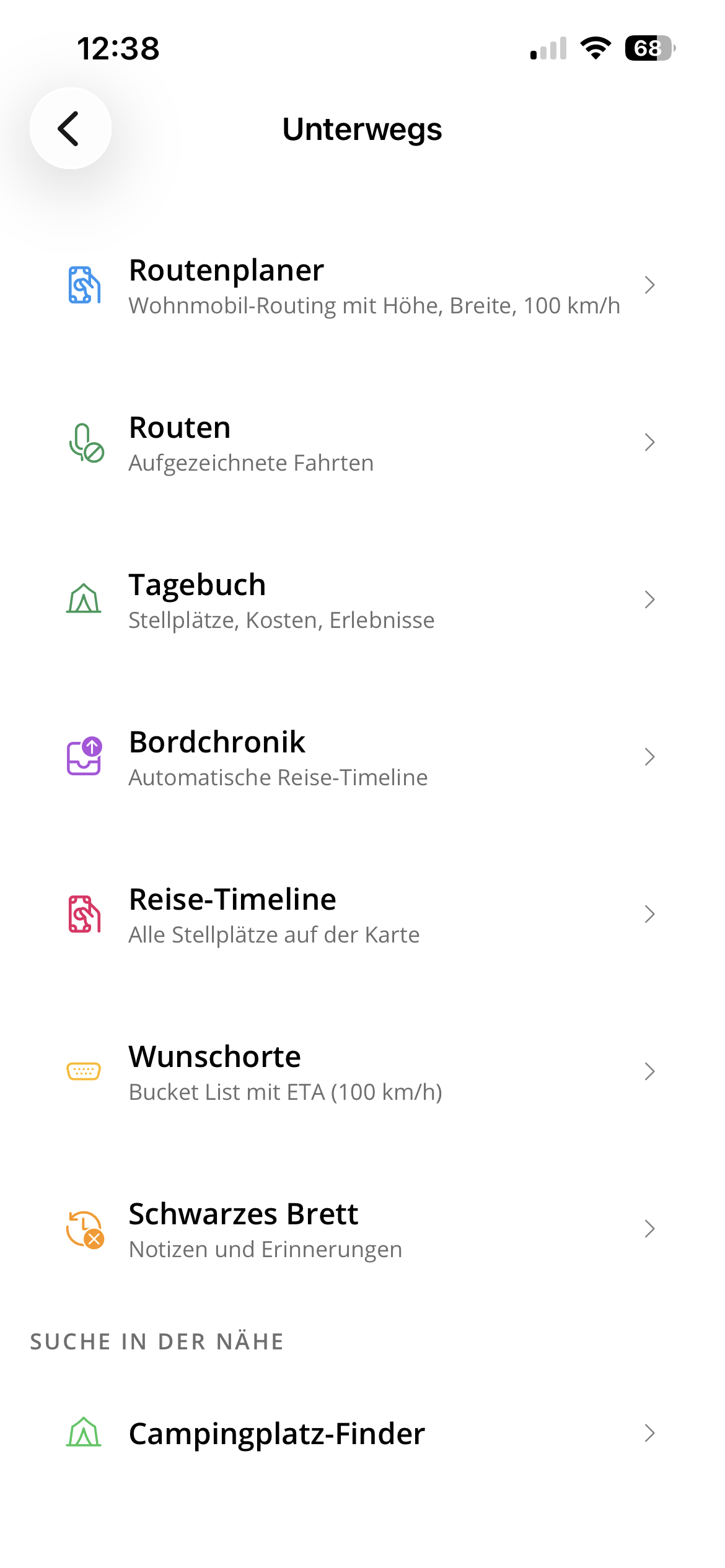
The native app for iOS, Android and macOS is the daily interface for all this data. It is currently German-only because it is built for our own use first.
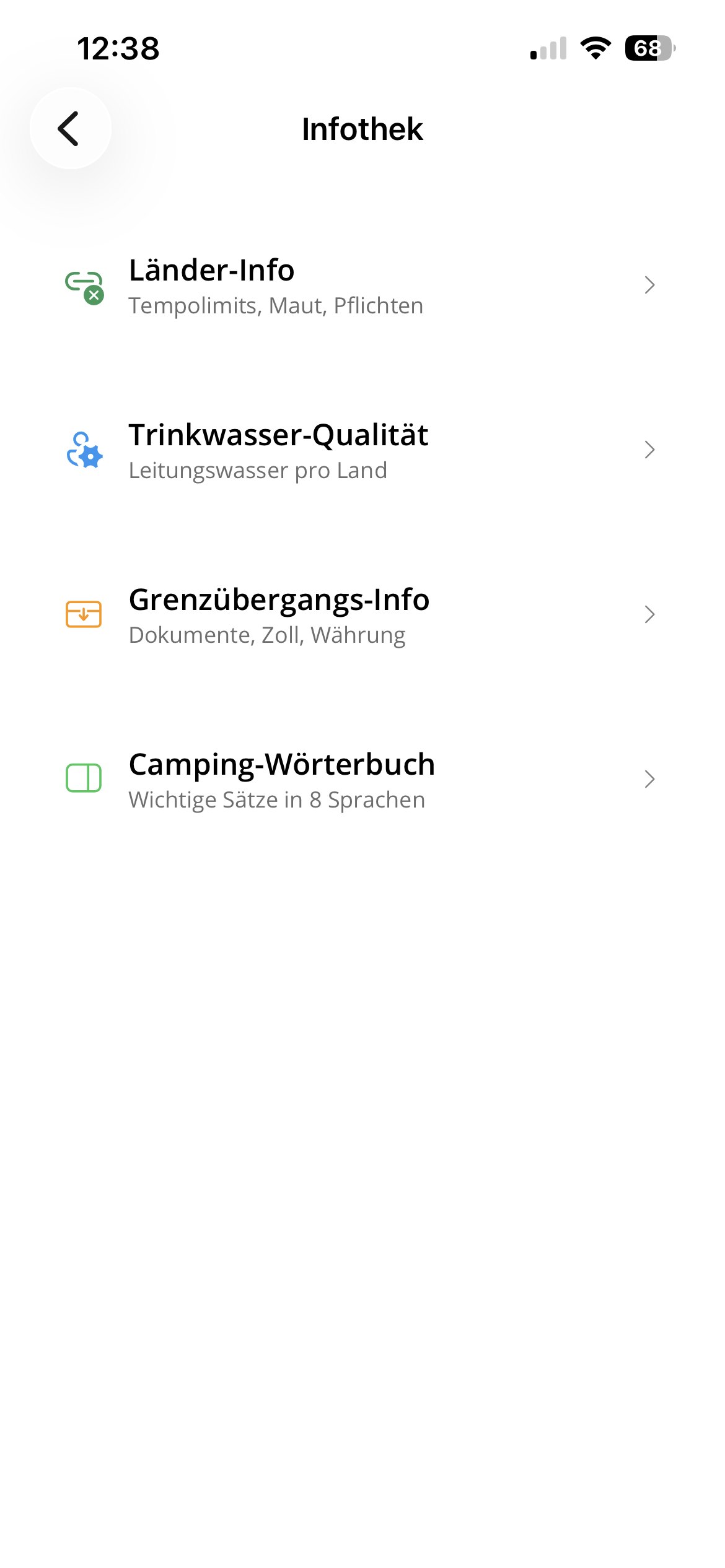
Routes, route playback, travel diary, chronicle, wish places, campsites, disposal points, country rules and emergency information live in one place.
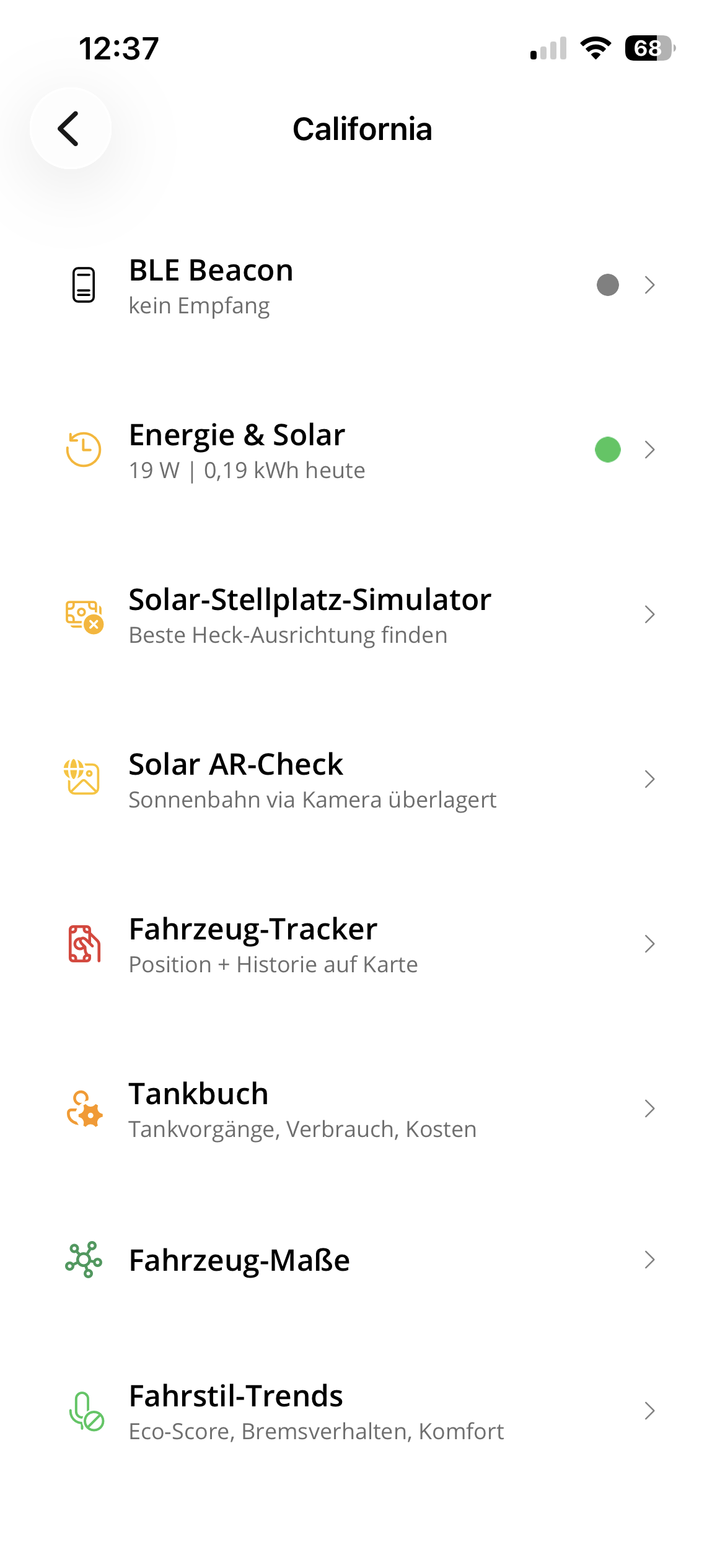
Solar, battery health, fuel log, tire pressure, dimensions, leveling, alarm, door and window status, indoor climate and damage logs are part of the same app.
Privacy and publishing
The system was built because existing products could not cover the workflow without giving up too much control over the data.
Live position is not published here. Public travel statistics are only shown when they are safe to show, and the travel journal is still being rebuilt.
The core stack runs on our own infrastructure: database, time-series data, cache, logs, workflows, maps, routing, geocoding and push delivery.
The website shows a curated public view. The private system contains much more operational detail, but the public pages intentionally avoid live tracking, internal addresses and sensitive infrastructure details.